Restored BARRANDE Memorial Plaque Once Again Adorns the Barrandov Rocks in Prague
The idea for this plaque originally came from none other than the writer Jan Neruda
An important monument has returned to its historic location: the National Museum has reattached the restored plaque in honour of palaeontologist Joachim Barrande to the Barrandov Rocks. This was made possible through precise craftsmanship – and generous support.
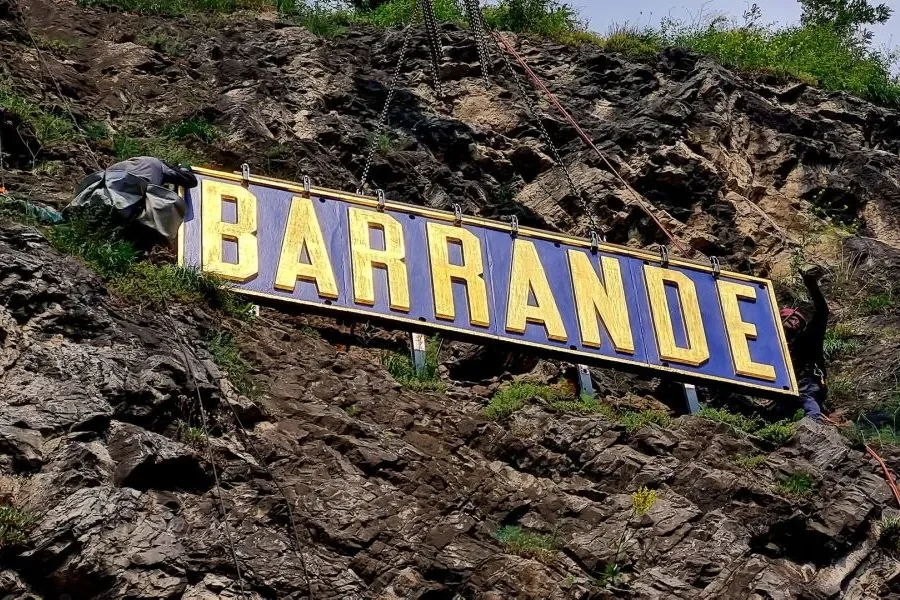
On Monday, 9 June, a significant piece of Czech scientific and cultural history returned to its rightful place: after six months in a restoration workshop, the National Museum reattached the historic plaque bearing the inscription BARRANDE to the Barrandov Rocks. The cast-iron plaque had been dismantled in November 2024 due to its deteriorating condition and was then professionally restored.
The idea for the plaque came from none other than writer Jan Neruda, who proposed it in 1883 in a feature article in Humoristické listy. The project was subsequently taken up by natural scientist, zoologist and palaeontologist Antonín Frič, one of the leading figures at the National Museum at the time.
Elaborate Rescue of a Monument
A preliminary investigation in 2023 revealed that the plaque was in poor condition. Corrosion and flaking paint made its removal unavoidable. Old layers of paint and rust were removed by fine sandblasting. The front was given a fresh coat of ultramarine blue paint, the letters were highlighted in yellow, and finished with a total of 13 grams of 24-carat gold leaf. The restored plaque was mounted on a stainless steel frame and fitted with new weather protection to keep out moisture and deposits while allowing air circulation to prevent further corrosion.
Who Was Joachim Barrande?
Joachim Barrande (1799–1883), a French civil engineer, came to Bohemia in 1832 with the exiled court of French King Charles X, where he worked as a tutor. In Prague, he met Kaspar Graf von Sternberg, the founding director of the National Museum, and discovered numerous fossils during geological explorations. Barrande devoted himself to palaeontology and became one of the most important researchers of his time. He left the National Museum not only his extensive collection of hundreds of thousands of fossils, but also his notes, specialist literature – and a legacy that continues to resonate today.
More from News